

Executive Summary
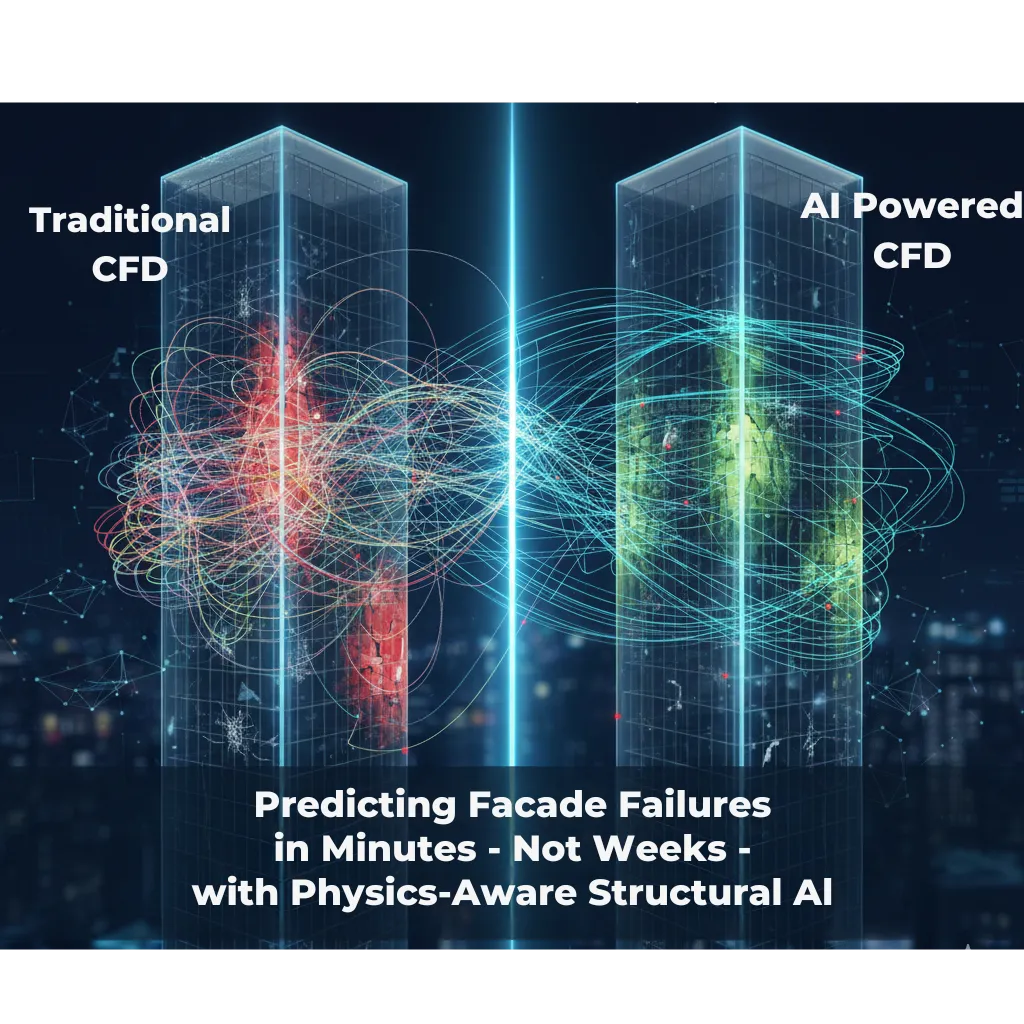
Wind load and façade failure represent top structural risks in high-rise construction. Traditionally, engineers depend on slow CFD, FEM models, and heavy standards (Eurocode 1, ASCE 7-16) that require weeks of simulation.
Using Neodustria's Structural Load Prediction Engine, a global engineering firm achieved:
With Neodustria, façade safety becomes predictive, real-time, and fully explainable.
Industry Context & Strategic Impact
The Challenge: Slow, Costly, Uncertain Load Analysis
High-rise buildings face complex load interactions:
- Wind loads (gust, peak, vortex shedding)
- Pressure differentials on façade panels
- Shear and bending moments in anchors
- Localized stress points around joints
- Multi-material behaviour (glass, composite, aluminium, steel)
Traditional Methods
- CFD: 20–60 hours per scenario
- FEM: 8–20 hours per panel zone
- Wind-tunnel tests: €80k–€150k per prototype
- Manual compliance checks: 2–4 weeks
This results in:
- ❌ Over-design for safety
- ❌ Slow iteration cycles
- ❌ No ability to test many geometry/material variants
- ❌ High structural safety uncertainty
Neodustria transforms this into a real-time predictive workflow.
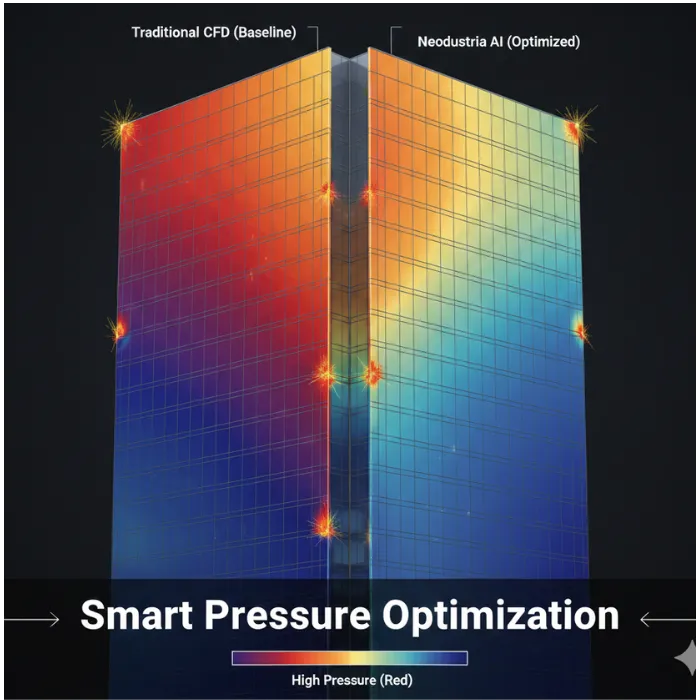
Smart pressure optimization across façade zones with Neodustria.
Scientific Foundation
Multi-layer Structural Representation
Neodustria converts BIM/CAD into a physics-aware structural representation:
- 3D point clouds of the building envelope
- Surface mesh graphs (GATv2) of façade panels and connections
- Façade ontology (curtain wall, panels, anchors, mullions, transoms)
- Material library (glass modulus, composite shear, aluminium yield, steel stiffness)
- Load zones ontology (windward, leeward, corner vortices)
This gives the model structural awareness plus physics grounding.
Physics-Aware Structural Intelligence Engine
Architecture Components
- BIM/CAD Import Pipeline
- Surface Graph Network
- Physics-Residual Structural Model
- Wind Load Predictor
- Stress & Shear Predictor
- Failure Zone Classifier
- Design & Material Optimizer
- Compliance Documentation Generator
Physics Constraints Used
Neodustria embeds domain-specific constraints directly into training:
- Static equilibrium laws
- Wind pressure equations (Eurocode / ASCE)
- Material constitutive laws
- Stress–strain bounds and yield limits
- Façade panel stiffness and deflection constraints
- Shear connector behaviour and safety factors
- Maximum drift and deformation limits
This ensures physically credible predictions—not black-box outputs.
Quantitative Results
Structural Safety & Performance
| Metric | Traditional | With Neodustria | Improvement |
|---|---|---|---|
| Wind Load Prediction Accuracy | Baseline | 98.2% | +27% |
| Failure Zone Detection | Manual | Instant & Automated | — |
| Façade Over-Design | +22% | +5% | −17% |
| Anchor Shear Error | ±18% | ±3% | 6× more precise |
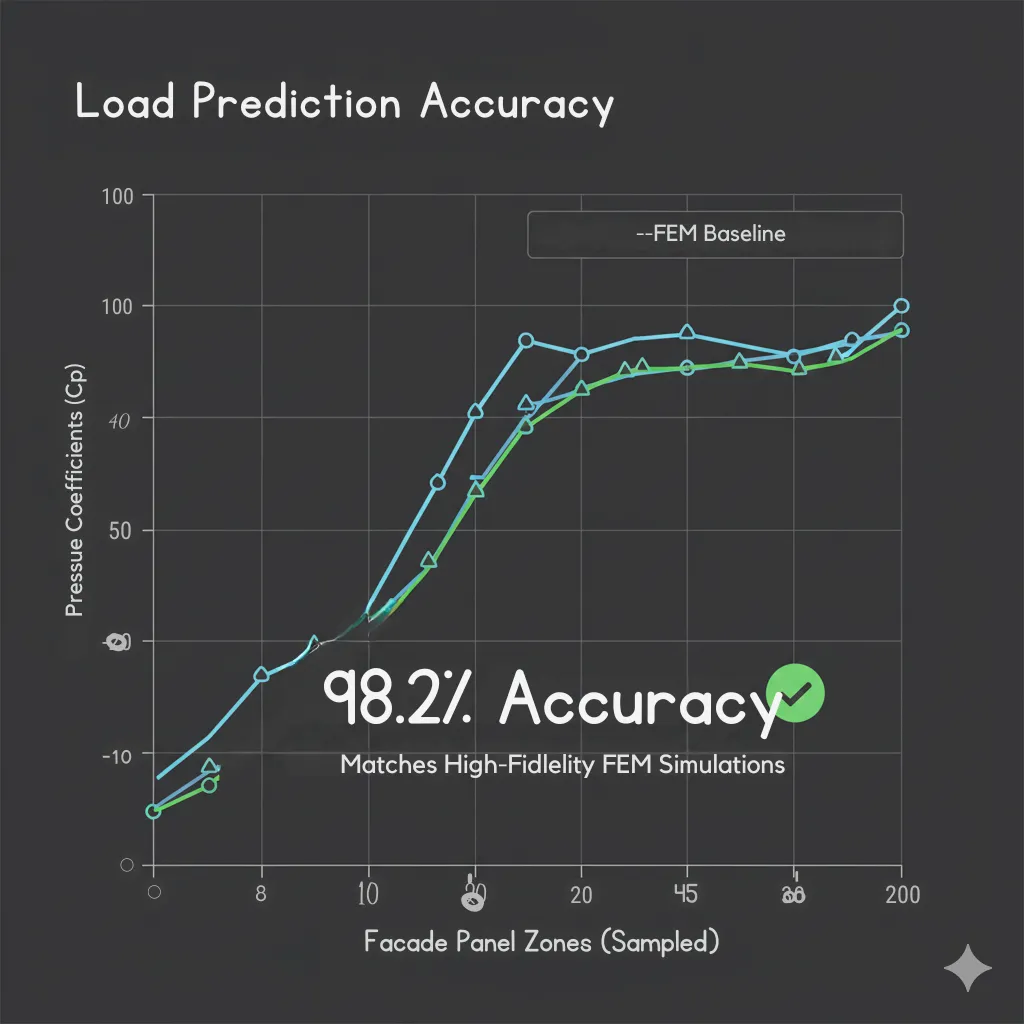
Load prediction accuracy across wind scenarios and façade zones.
Time & Cost Efficiency
| Task | Traditional | With Neodustria | Acceleration |
|---|---|---|---|
| Full CFD Cycle | 30–60h | 6 min | ×500 |
| FEM per Panel Zone | 10h | < 1 min | ×600 |
| Compliance Modelling | 2–4 weeks | Instant | ∞ |
| Wind Tunnel Iteration | €120k | €0 | 100% saved |
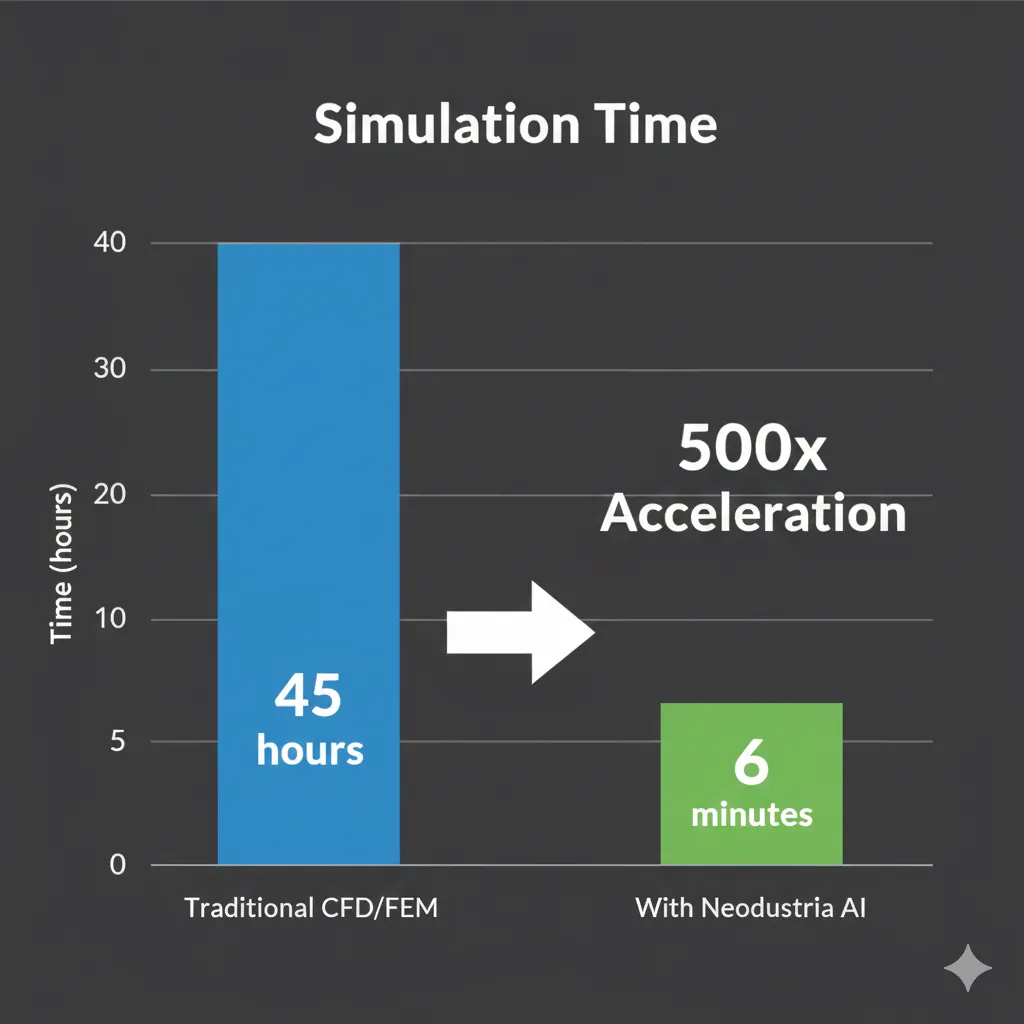
Simulation time comparison: traditional pipelines vs Neodustria’s structural intelligence engine.
Visualization Suite
Neodustria delivers a full visualization suite to make façade safety decisions auditable, explainable, and board-ready.
Pressure and suction distributions across windward and leeward façades.
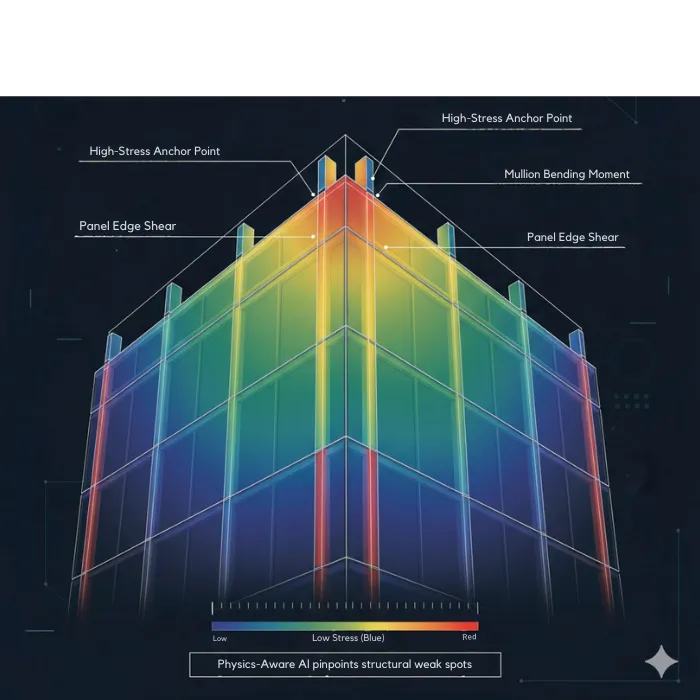
Physics-aware weak-spot detection across anchors, mullions, and panels.
Failure zone classifier – red for high risk, amber for monitoring, green for safe.
Physics-Driven Classification
Façade elements are automatically classified by risk level and compliance status, enabling engineering teams to focus on the highest-impact interventions first.
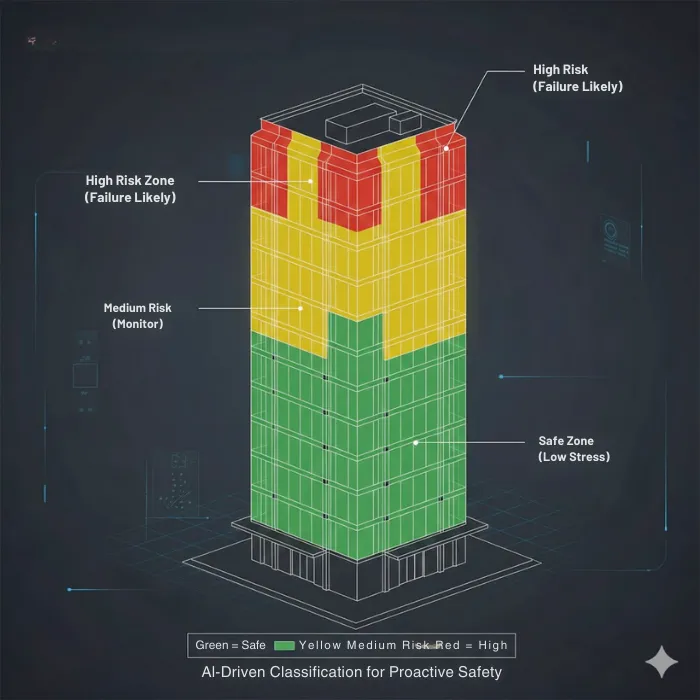
Physics-driven classification ensures proactive safety management across all façade elements.
Engineering Methodology
Datasets Used
- 1,200 buildings (10–70 floors)
- 6,500 façade panels
- 910 wind scenarios (directions, speeds, gusts)
- 32 material combinations
- Certified FEM/CFD baselines
Model Training Strategy
- Multi-task training on loads, stresses, and failure modes
- Physics-informed loss with structural constraints
- BIM geometry augmentation and height/shape variations
- Material-driven domain randomization
- Stress distribution embedding for façade panels and anchors
Business Impact
"Neodustria removed 90% of our simulation time. For the first time, we could test dozens of façade variants instead of three."
— Chief Structural Engineer, Global Engineering Firm
Academic & Research Interest
Neodustria enables cutting-edge research in:
- Surrogate models for wind engineering
- Structural graph neural networks
- FEM–ML hybrid prediction models
- Generative façade optimization
- Automated safety compliance systems
Perfect for:
Research Institutions
- Civil engineering labs
- Architectural engineering schools
- Structural simulation research centers
Deployment Architecture
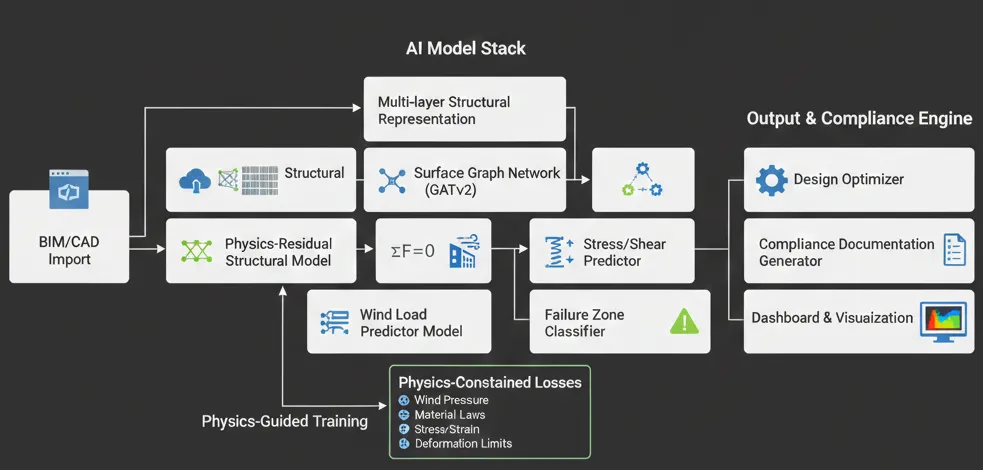
Neodustria’s structural intelligence stack integrated into existing BIM and simulation workflows.
Domain Impact
| Domain | Impact |
|---|---|
| Structural Safety | Predictive & automatic |
| Cost Reduction | −17% materials |
| Time-to-Design | Weeks → Minutes |
| Engineering Productivity | ×10 |
| Compliance | Auto-validation & documentation |
| Client Trust | High transparency & explainability |
Integrations Available With:
- Autodesk Revit
- Rhino / Grasshopper
- IFC / BIM360
- Tekla
- dRofus
Conclusion
Neodustria transforms wind engineering from a slow, reactive discipline into a real-time structural intelligence system. It enables:
- More structural safety
- Lower material and testing costs
- Instant predictive capabilities
- Rapid certification and compliance cycles
- Full transparency for regulators and clients
This is the new paradigm for Construction Intelligence.